Cormac McCarthy
Not to be confused with the dummy...

I recently received the gift of a three-pack of Cormac McCarthy books - “No Country for Old Men”, “Blood Meridian” and “The Road”. I have read them all, and NCFOM, twice. I like McCarthy’s writing, find his themes interesting, if disturbing, but I don’t have the literary framework or background to understand why he wrote the stories he did. But I do read what others have written about his books.
In those three books I noticed that two characters were shot by an arrow in the lower leg. Hmm, didn’t Achilles have the same thing happen to him? We all know about Brave Achilles from Phthia (say that three times fast!), dipped in the River Styx by his mother Thetis, later shot in the heel by Paris, the original one, not the hotel heiress. Sure, he slew Hector, but that’s another story. But that is the extent of my knowledge of the classics.
One character survived his wound only to die in a much worse way, the other succumbed as an indirect result of taking that arrow. Neither of their fathers was an argonaut, so…
Good, evil, wisdom, they are all in those three books. The subjects about which McCarthy writes are difficult one - violence, bloodshed, slaughter, murder, mayhem, unaccountable random killing, carnage, brutal savagery, mass hysteria, end of times, mass extinctions, chance, predestination, you know, the same things one sees in the news every single day.
So why read such stories? For me McCarthy’s writing is the hook. He lived in extreme poverty, refusing to work regular jobs to pay the bills, all in pursuit of his art. He devoted all of his waking hours and all of his effort towards writing. Are such sacrifices necessary to produce great art? I have no idea. In his case it paid off, eventually. He had a way with words unlike anything I have else I have ever read. I notice something new everytime I read or reread his work. He had real talent and made the most of it.
Here is an excerpt from No Country:
Ed Tom Bell visits his uncle Ellis.
Ed Tom “How many cats you got?
Several. Depends on what you mean by got. Some of them are half wild and the rest are just outlaws. They run out the door when they heard your truck.
Did you hear the truck?
How’s that?
I said did you … You’re havin a little fun with me.
What give you that idea?
Did you?
No, I seen the cats skedaddle.”
They then talk about the criminal that shot and crippled Uncle Ellis.
“You wear out, Ed Tom. All the time you spend tryin to get back what’s been took from you there’s more goin out.
…
Anyway, you never know what worse luck your bad luck has saved you from.”
———
I can truly relate to Uncle Ellis. He is hard of hearing, rarely leaves his house, has cats, and is care worn by life.
In the book McCarthy devotes 17 pages to that visit and it is, for me, the spiritual core of the story.
Ed Tom’s thoughts are printed in italics to set them off from the rest of the book. The right way to read those passages is in Tommy Lee Jones’ voice.
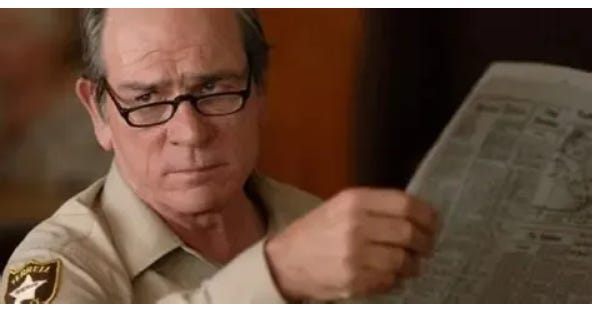
His last monolog is profound, at least to me, and it is well done in the Coen Brothers movie of the same name. His wife Loretta is well acted by Tess Harper, and she is a perfect foil for Ed Tom’s gruffness.
I also have to mention Kelly Macdonald who portrayed Llewellyn Moss’ wife Carla Jean. For someone from Glasgow (Glahz-gah to those who know), she nailed the West Texas accent. Llewellyn’s kindness is what sets the plot in motion. Let that be a lesson to you all - take the satchel full of money and don’t go back.
Cormac McCarthy had a good ear for local dialects and Ed Tom Bell’s speech patterns and idioms are unique to his character. That is great writing when you can identify one character among many from the same area just by how he speaks.
An interesting aside about the movie is the casting of Woody Harrelson in the role of Carson Wells as Woody’s father in real life was convicted for murdering federal judge John H. Wood Jr. in San Antonio, an act mentioned in the book and the movie. The intersection of life and art in that case is too tangled to unweave in this story.
This is a drawing of the main characters in “Blood Meridian” done by Jarrod Owen.
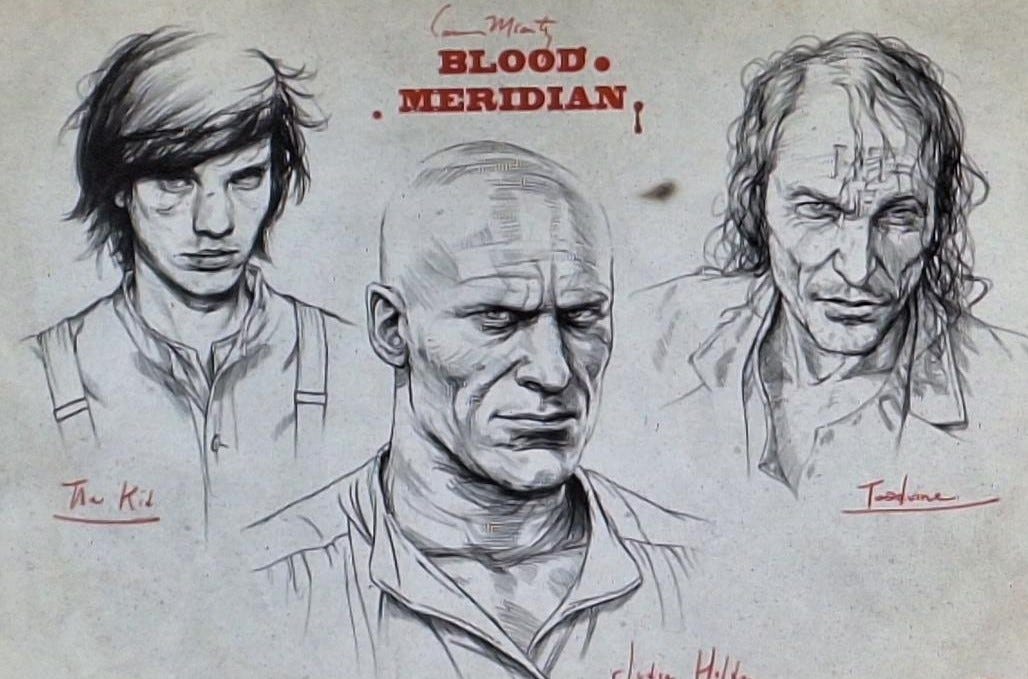
It’s hard to depict a nearly 7 foot tall hairless giant with a face the color of tallow who, by all acounts is not of this world.
This book was difficult to read, and I am currently rereading it. Now that I know where the story goes I am paying more attention to the writing.
I recently read a substack article by Aaron Gwyn that shed light on what this book was based on. That gave me new insight into what McCarthy was going for.
Aaron Gwyn on "Blood Meridian"
Turns out that McCarthy was familiar with Gnosticism, and after doing some in depth research - I read a Wikipedia page about it - now I know more than I used to. I still don’t have a clue, but there you go.
And that’s another thing, if it is pronounced “nostic” shouldn’t the opposite be “a-nostic” rather than “ag-nostic”? Inquiring minds want to know.
Caution, gentle readers, do not delve into that book unless you can separate yourself, that is, get some perspective on these stories, remind yourself that it’s just a book. It’s rough.
The third book of this trio is “The Road”. This too, was a tough read. It helped when I saw the movie that was made based on that story. It’s not your typical father and son coming of age story, that’s for sure. Life is tough when most life on earth has been snuffed out by an unnamed apocalyptic event. It is a story of survival and bonding during a heroic journey, and even through their hardships the father manages to teach the son about life.
Perhaps the movie is too sweet, as in the end, the family that takes in the son includes the actress Molly Parker, and how can you not like her, eh? They have a son and a daughter, and best of all, a dog, a good dog that looks like a working dog of some sort - Australian shepard, perhaps. Best dog ever! Also, the words used to describe the landscape and the hardships faced by the characters could not be depicted on film. You just can’t find that many burned out forests and cities full of junk cars in which to make your movie. I think a lot of it was filmed in Oregon, just saying.
Honorable mention to Robert Duvall, who, as always, was great in this movie.
Cormac McCarthy has written many other novels, none of which I have read. I heard the title “All The Pretty Horses” and thought it was something along the lines of My Little Pony. I could not have been more wrong.
Those three books are what I have been reading this year. You have to be tough in this life, that’s for sure, and another certainty is that I can’t write book reviews. I can only tell you what I read. I will add that I found typos in all three of those books - those are the hazards of writing and publishing. I used to be a professional proofreader and while I can’t see my own typos I can pick them out in the work of others.
In one book laths are mentioned - that is the plural of lath, which is the support for wet plaster when it is used in construction. I have encountered quite a bit of it in my work in renovation and demolition of old buildings. The word used in the book is “lathes”, which are tools that I have used to turn wood and metal. The addition of an “e” makes a big difference in what is being referred to. I had a mental image of plaster being applied over an aglomeration of power tools. Made me laugh.
In “No Country for Old Men” Llewellyn Moss is asked about a necklace he is wearing. He says it belongs to someone else and that it is a boar’s tush. Well, that is unseemly. I think that a boar’s tusk is the more traditional part of a wild hog’s anatomy that one wears around one’s neck. A “k” and an “h” look similar, and the two letters aren’t far apart on the keyboard, so I assumed it was just a typo, not a fashion statement. I could be wrong, after all, as Ed Tom mentions he never thought he would see the day when the youth in Texas would be sporting green hair and bones through their noses.
Sorry, Ed Tom, they are. It is no longer a country for old men.
Did I ever send you a review copy of Western Terminus, you cheap bastard? Text me.