My GMC

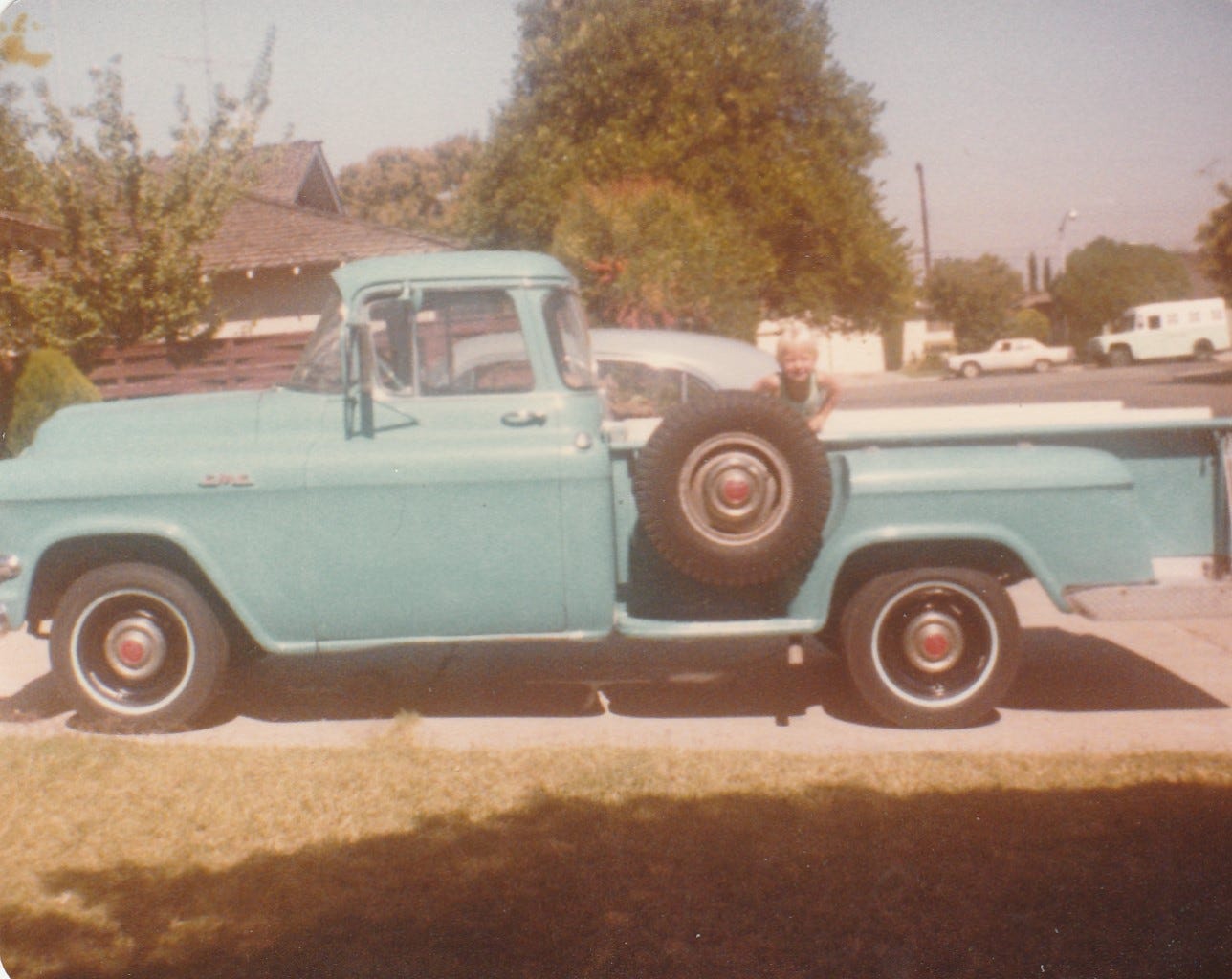
This is a picture of my oldest son in the bed of my GMC, with new narrow white walls, in the driveway of my place in Santa Clara. My neighbor’s ‘48 Cadillac Sedanette can be seen in the background. That was his daily driver.
After moving to California I needed a second vehicle. While driving down Sunnyvale Saratoga road one sunny day I saw a nice looking GMC parked on the shoulder with for sale sign in the windshield. I couldn’t believe such a clean, undamaged truck would be for sale - I stopped, got the phone number, and when I got home, called the owner. Next thing you know I was the proud owner of a 1957 GMC 100 long bed stepside with a wide rear window and dual sidemount spares. It had the 270 cubic inch straight six engine which was the next to last evolution of the GMC group 1 engines that had started out as Buick straight sixes (for more information on those engines, listen to Bob Dylan’s song “From A Buick 6”). They were rated at 133 horsepower and 244 lb/ft of torque due to their long stroke compared to their bore diameter. My truck had a factory 4 speed transmission with a “granny gear” first gear with a 7.06:1 ratio that wound out at about 3 mph - you could pull a house off its foundation with that engine/transmission combo.
I commuted to work in my good old truck, parked next to a ‘35 Ford pickup, a ‘60s Ferrari with peculiar canted quad headlights, a Citroen SM, a ‘67 Shelby 350GT, an early ‘70s Aston Martin V8, a ‘61 Chevy Impala bubble top, a Chevrolet Vega (non-Cosworth), you get the drift - everyone had their own style and some of us really liked cars.
I have always changed the oil in my vehicles. This ‘57 had a remote oil filter mounted on the inner fender in front of the firewall. Two oil lines connected it to the engine. I contained a replaceable paper element, had a detachable circular metal lid. The entire engine oil system was powered by an oil pump located in the oil pan bolted to the bottom of the engine block, but I am getting ahead of myself.
One bright Saturday morning I drained the oil and changed the filter element. Standard stuff, but on this occasion I got distracted and failed to replace the cap on the filter body. I drove across the street to the shopping center and on my way home I noticed a trail of fresh oil on the road. Oh crap - I left off the cap!
I replaced the lost oil but it was too late - even a minute or two of low or no oil pressure had scored the rod and main bearings. Huge oh crap!
This truck was old enough that in addition to a water temperature gauge and an ammeter on the dash, there was also an oil pressure gauge. Topped up with oil the system was still running within spec but the damage was done - sooner or later I was going to have to replace all of the bearings associated with the crankshaft. But for now, the engine wasn’t too damaged to drive.
We packed our stuff into our trailer, piled into the cab and headed east - yep, I drove across the country on a wing and a prayer. I kept an eye on the oil pressure the whole way, and eventually we arrived in Maryland.
My automotively inclined friends marveled at the pristine quality of the rust-free California sheet metal and commented on the pure-’50s color of the truck, which I am told was “Turquoise”, a popular paint choice of that era.
I settled in Hagerstown Maryland, in Washington county. The place we rented had an enclosed garage and once I could I bought another car and parked the truck until I could work on it.
I bought a ‘66 Ramber Classic for the missus, a terrible six cylinder with an automatic transmission. I got a ‘63 Volvo P1800 with a body built by Jensen in England. A car with Swedish mechanicals and a body/frame combo that apparently had the rust installed at the factory. I commuted in that car for a while, then the engine seized - turns out it had a cracked block and water was leaking into the lubrication system. I sold it at a loss and bought a ‘67 Volvo 122S - that proved to be more a bit more dependable.
I found work where I could, including taking on the job of demolishing my landlord’s old carriage house. That was a tough job, demolition is dangerous, and when I got down to just the framing, the whole structure was in danger of collapsing on me. I persisted and in the end, attached a rope to the rafters and pulled it over from a safe distance. The good part is that I was able to salvage a large number of oak rafters. I sold some and I kept some. The latter proved useful when I set about repairing the GMC engine.
I used them to build an A-frame over the front of the truck and pulled the hood and some other sheet metal off the front. I drained all the fluids, removed the radiator, unbolted the motor mounts, and disconnected the transmission from the bell housing.
Once the engine, in theory, was free to move, I got a block and tackle, as my old boss Corey had taught me, and gave the rope a tug. Yep the engine could be lifted off the chassis, but the pulleys allowed it to settle back in place once I stopped applying force. Hmm, that’s not going to work.
I went down to the local rental place and got a chain hoist. Much better - it had a ratchet that maintained any progress I made against the relentless tug of gravity. I got the engine out of the truck and then I built an engine stand out of scrap plywood. I designed it so that I could invert the whole assembly leaving the valve cover and cylinder head in place - no reason to disassemble more of the engine than needed.
Once it was upside-down I removed the oil pan, oil pump and other widgets one finds in the bottom end of a stout power plant.
Then I unbolted the four main and six rod bearing caps. One thing I could not unbolt was the flywheel - when I applied torque to the bolts holding it in place the entire assembly rotated. I had no option other than leave it attached to the crankshaft.
At the end of a long day of wrench twisting I gave a mighty heave and was able to lift the crank and flywheel out of the block and set them on the work bench. That took the last of my strength and I called it a day and went upstairs to rest.
So, what to do? I now had the scored crankshaft freed from its morings but I needed to get it repaired. Luckily I knew a parts guy who worked at a NAPA store in Frederick and in that store they had a machine shop with a lathe capable of precision turning all the journals on a crank. It is a large metal lathe capable of precision turning - and by precision I mean accuracy down to a ten thousandth of an inch.
As soon as possible I loaded the crank/flywheel into my trusty if rusty Volvo and hied to the store. I explained the situation, the machinist agreed that the crank was deeply scored and that he could handle the job. He was also able to unbolt the flywheel, but I never learned how.
I have spent the last 20+ years turning wood and I used a metal lathe in college and I have nothing but respect for anyone who can take a random crankshaft from any given engine, mount it correctly, measure the diameter of all the journals, figure out the throws of the rod journals, calculate what size bearings can be used and turn it down to fresh, properly finished metal and provide all the parts needed to make the engine run again.
I learned about a malleable plastic product called Plastigauge - thin pieces of plastic that one places between the throws of the crankshaft and the new, oversize bearings. Then you torque down the bearing caps and that mashes the plastic flat, and like a penny on the railroad tracks, it now has a new width and shape.
Unbolt the bearings, pull out the now squashed Plastiguage and then measure how wide the plastic has become and one can determine the precise clearance between the bearing and the crank - it measures indirectly a space that you cannot measure directly. Very cool. It allows you to be certain that the machinest and the parts guy did their jobs correctly. The clearance specs are .001” - .0015”, enough room to allow oil to circulate but not so great that all the pressurized oil doesn’t escape - it’s a fine line. One also has to check the thrust bearing to ensure that the whole rotating assembly isn’t moving longitudinally in the block - much accuracy is required to keep an engine running reliably.
Assured that parts were correct I applied the startup lube to the crankshaft and the inside of the bearing shells then I torqued everything down to the specified tightness. Using an oil soluble assembly lube is crucial to prevent damaging all the new bearings you just worked so hard to install.
Reassembly continued, with the oil pump installed, the new oil pan gasket was bedded into the gasket sealant, everything torqued to spec, then I righted the engine and put on the harminic balancer, taking care to align the timing marks on the crankshaft with those on the camshaft. I bolted on the flywheel, and with that, I was ready to return the engine to the engine compartment.
I hooked up the chainhoist and started lifting. The entire engine weighed close to 600 pounds and it was nice to have it hanging on a chain, weightless, rather than muscling it around on the ground.
I did need help guiding that mass back to the transmission - getting the splined shaft aligned and at the proper height was a two person job, but once that was done, it was just a matter of bolting everything back in place. Bell housing, engine mounts, all the plumbing and wiring connections, exhaust header, radiator, sheet metal, bam, one after another they all went back together.
Of course, the very last sheet metal bolt that secured the radiator shroud to the grill was a problem - it seriously took me an hour to get that lined up and squared away. Frustrating, but I got it done.
I fired it up and took short test drives around my neighborhood to make sure everything was working properly. Everything was.
Eventually I drove over to visit some friends near the town of Wolfsville, and while driving home on the National Pike, coming down the western slope of South Mountain, using engine compression to minimize the braking load, the engine stopped. Just stopped. And it wouldn’t start. This was in 1977, long before cell phones, so I had to walk to the nearest farmhouse and ask to borrow a phone. These were simple mountain folk, and while they didn’t shoot me on sight, they did give me a lecture on getting right with Jesus, and I called a tow truck and told them that I would indeed mend my ways.
Got the truck towed home, and stowed in the garage, again. Time passed. We had a dreadful winter, worst one I ever lived through, with temperatures below zero for protracted periods of time, more snow than I could stand, and in February of ‘78, my son was born.
I not only wanted to get out of that depressed part of Appalachia, but now that I had a son, I had to. So once it was warm enough I resumed work on the GMC.
For the life of me, I couldn’t figure out what had happened. It cranked over okay, there was no obvious mechanical problem like a connecting rod protruding through the block, no grinding noises, it simply wouldn’t fire up.
Several mechanic friends said “It jumped timing”. Well, I had just been looking at where the distrubutor intersected and was driven by the cam shaft and that seemed not only implausible but impossible. These are helical gears, solidly mounted in their respective locations, held down with bearings and suitable hardware. No way they could have “jumped”.
I pulled the distributor and checked for stripped teeth on the driven gear. There was no damage. I inspected the camshaft, once again, no visible damage. But at this point I just wanted to fix the truck and get it back on the road, so I rotated the distributor, completely changing the timing, in theory, and bolted it down.
What do you know - that fixed it. To this day I don’t know what happened, or how the timing was altered so severely, but I accepted the situation as a mystery that will never be solved and was happy that the engine now ran.
Phew.
We packed up all of our stuff, looking like the Joads only in a more stylish truck, and headed west.
Two things one should know about this truck - when it was fully laden and towing a trailer it got 10 miles to the gallon. Also, the gas tank was located directly behind the bench seat in the cab. So much for safety. The connection between the filler cap and the gas tank was a semi-rotten piece of rubber hosing that, for the most part, didn’t leak.
We drove west on I-70, which ran right by where we were living. In Kansas things got weird - the carburetor became a digital device - it was either full on or full off. In traffic one needs more of an analog control of one’s velocity.
We pulled into a campsite somewhere in eastern Kansas to sort out the problem.
Little kid there had a dog - kind of a small dog, perhaps a Wiener dog mix. “What kind of dog you have there?”
“It’s a German Shepard!” he said proudly.
“Are you sure?”
“Maybe it’s a Datsun.”
We left it at that.
I drove into town to find a parts store. “My carb is acting up, do you have a rebuild kit?”
Parts guy looked at the carb, looked at his parts books, “Nope.”
“Well, I really need to fix this thing so I can get back on the road.”
Guy goes and gets the old timer from the back of the store.
“Hell, I recognize that carb, that’s off a tractor!”
Gets the matching new carb, in the box, I buy it, install it, and go on my way. What are the odds that a parts store in rural Kansas would have the part I needed, in stock.
The correct answer is 100%, because they did.
Stayed on 70 all the way to Denver. Then up into the Rockies to Eisenhower Pass. It was slow going there at the top, and at some point I pulled over to give the truck a rest. The altitude was over 11,000 feet and I think that is the highest I have ever been. The air was thin and I was not inclined to do any wind sprints.
Headed down to Utah, and got on Route 50 when 70 ended. Known as the “Loneliest Stretch of Highway” in the US, my main concern was making it between gas stations. The old Jimmy could manage 10 MPG, the tank held 10 gallons, and simple math indicated that if the gas stations were more than 100 miles apart I was going to be in deep sand.
There was one stretch where the gas station had a sign that read “Last Gas For 100 Miles” - well, I think I will fill up there. I didn’t have a spare gas can, that would have been helpful. Instead I just filled the tank all the way up to the top of the filler spout and accepted the gas fumes in the cab.
If you have ever been on that highway you know that there are some climbs as well as some descents. On the downhills I would shut off the engine and coast - one upside with 1950s technology was nothing was power anything or automated this or that. No air conditioner. The brakes were single circuit unboosted drum brakes, the transmission was manual, and since it was day time, I didn’t even need to turn on my headlights. I would crest a hill, shut it all down, and coast until my forward momentum was almost gone.
Using that method I made it across those 100 miles, and when I reached the next gas station the fill up was only 9.6 gallons, meaning I could have made it another 4 miles, easy! Piece of cake, well withing the margin of error. Yeah, that’s not cutting it close, not even a little bit!
We got to California, I found work, I continued to drive the truck, and eventually my second son was born. That meant that when we decided to move back east the truck had to go. There wasn’t enough room on the bench seat for all 4 of us. I sold it to a classmate and last I saw of it was him driving it recklessly around town, and I assume he wrecked it.
There were more more mechanical adventures, like when there was a clunking in the drivetrain, which I traced down to the spider gear bearing cap bolts coming loose (What the hey? How did that happen?), but I sorted it out and what can I say - I was very familiar with all of the various systems on that vehicle by the time I sold it. Do I miss that old truck? Of course, but road salt in the east would have eaten that curvaceous body work like termites in a pine shed.
I am sure I have more pictures of that truck around here somewhere, but I can’t find them. Words will have to do for this story.
